
How to Search Civil Dockets
The Cannon County Online Court Records System covers public Circuit Court and General Sessions cases. Civil is one of its two case-type choices. Enter a party name or the trailing digits of a formatted case number. Then pick the likely court and year. Chancery is not an option on the public form. So those matters go straight to the Clerk and Master. Juvenile, child-support, and municipal records likewise need their own routing and access checks.
A careful Cannon County civil docket search follows these steps:
- Identify whether the matter belongs to General Sessions, Circuit, or Chancery before searching.
- Select Civil and the correct court in the county portal. Both court and case-type filters must be selected.
- Enter a complete party name, or enter only the numeric sequence after the final hyphen in the Case Number box.
- Review the case year, style, and court before relying on a match, then compare it with the dated docket archive.
- Ask the proper clerk for the filed pleading, order, judgment, ordinary copy, or certified copy that is actually needed.
When the index comes up empty, call the Circuit Court Clerk at 615-563-4461, email katinageorge.cannoncircuit@gmail.com, send mail, or visit the counter at 200 West Main Street in Woodbury. Chancery records are different. The Clerk and Master, at that same courthouse, keeps them and answers the phone at 615-563-5936.
Cannon Civil Docket Archive Rhythm
Cannon County posts separate landing pages for General Sessions Civil and Circuit Civil dockets. Each states that new dockets appear on the Friday before the hearing week. Their archives reach back to October 2020. That rhythm is handy when you know a hearing week. It helps when the case index fights you. It also means an early look may find the next PDF not yet posted. The county's General Sessions civil docket archive is the official landing page for those dated calendars.
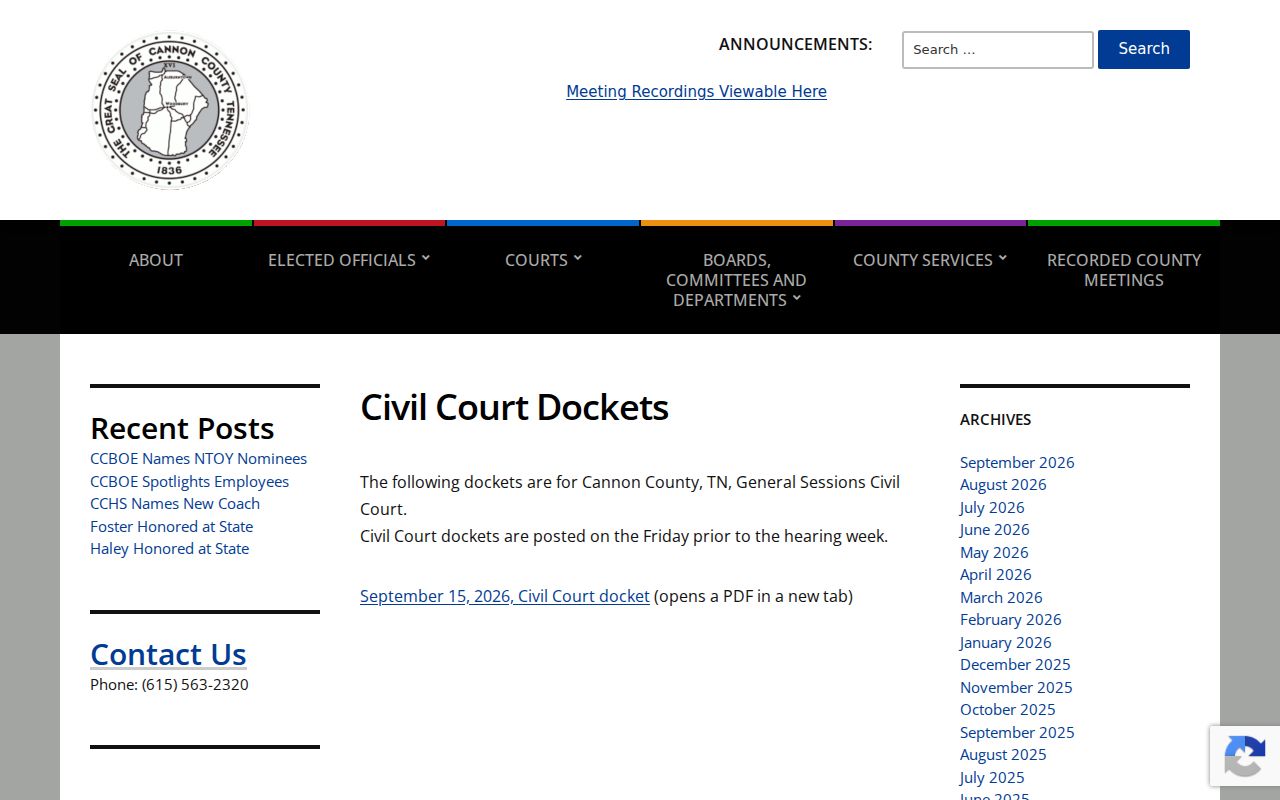
The page gives you a hearing-week route and nothing more. Its PDFs cannot replace the clerk's full civil case file, and a hearing listed there does not prove one took place. Save the landing-page address with any PDF you download. A current link can be replaced later. Note the docket date and the date you retrieved it. A continuance, judgment, or dismissal may come later. It may show up only in a new calendar or the clerk's event record, not in the copy you saved.
What a Civil Docket Shows
A sample Cannon County Circuit civil docket lists the selection date and time, case type, sorting method, hearing date and time, judge, case style, local case number, party-role labels, filing date, and matter type. Two labels deserve a closer look. "Selected By" and "Sorted By" describe how the calendar was built, not any legal ruling. A case classification is just a category. Reading facts into it that the file never states is a mistake.
| Case Number | Circuit civil examples use 8CC1-YYYY-CV-N; the portal searches the digits after the last hyphen. |
|---|---|
| Case Style | The caption used to identify the parties and distinguish one case from another. |
| Filing Date | The recorded date for the case or listed filing, not necessarily the date of a later setting. |
| Hearing Fields | The scheduled date, time, judge, and matter type shown when the calendar was produced. |
| Final Record | A filed order, judgment, dismissal, or certified clerk copy is stronger proof of the result than the calendar line. |
A docket row is a schedule and index clue. If you need the complaint, answer, motion, exhibit, or judgment itself, ask the clerk whether the document image is public and on hand. The portal publishes no complete statement of its image coverage, update interval, or retention period.
Choose the Cannon Civil Division
Civil court is not one office in Cannon County. General Sessions, Circuit, and Chancery each keep distinct roles and schedules. The county trial portal offers General Sessions and Circuit checkboxes. The Clerk and Master holds the Chancery records. General Sessions civil and Circuit civil records live with the Circuit Court Clerk. That office maintains and processes them. Pick the wrong route and the search may return nothing, even when a valid public case exists.
| Civil route | Local access point | Important limit |
|---|---|---|
| General Sessions Civil | County portal, civil docket archive, Circuit Court Clerk | Jurisdiction varies under Tennessee law and local authority. |
| Circuit Civil | County portal, Circuit civil archive, Circuit Court Clerk | A calendar line is not the complete Circuit case file. |
| Chancery | Clerk and Master | No Chancery checkbox was visible in the county public portal. |
| Child Support Magistrate | Office route published through the Circuit Court Clerk | It is not interchangeable with an ordinary General Sessions civil docket. |
The Tennessee clerk directory helps confirm which clerk holds which record. Do not send a civil trial-file request to the County Clerk. That office handles titles, registration, permits, marriage licenses, taxes, and county legislative records.
Types of Civil Cases on the Docket
Cannon County civil records cover more than one kind of dispute. General Sessions can be the starting point for small claims and other matters within its authority. Circuit Court holds general civil jurisdiction. Chancery is an equity court with its own clerk. A docket classification names the court's category, nothing more. It does not establish all claims, defenses, or facts on its own.
- General Sessions civil claims and small-claims matters within local jurisdiction.
- Circuit civil actions and appeals that fall within Circuit Court authority.
- Property, contract, tort, and other civil claims when filed in the proper court.
- Domestic-relations case types shown on public Circuit calendars, subject to record restrictions.
- Chancery equity matters held through the separate Clerk and Master.
Family and child-related files deserve extra care. Some contain sealed, redacted, or confidential material even when a basic setting is public. Give the custodian the court and case number, and ask which portion can be inspected.
Cannon Circuit Civil Calendar Route
The Cannon County Circuit page lists the first four Mondays of each month at 9:00 a.m. for the civil division. Scheduled cases are heard from that start time. That pattern gives useful context. It does not confirm an individual setting. Before relying on a particular date, check the case index, the current docket, any notice, and the clerk. The Circuit Civil docket archive is the county's official page for posted Circuit calendars.
These calendars show the local route. They promise no complete download. A Circuit case number on a Cannon County civil docket follows the 8CC1-YYYY-CV-N pattern. Keep the whole number when you contact the clerk. The county portal's search box asks for only the last numeric segment, yet the clerk needs the full case number on the phone. Post-hearing events may never appear online. The Friday posting rhythm is routine practice, not a promise that a late reset or cancellation lands on the calendar in time.
Settings and Hearings on Civil Dockets
A civil setting marks a planned court event. It might be a motion hearing, a trial setting, or a status event, depending on the label the local calendar uses. The setting never proves the hearing took place. Schedules in Cannon County differ by division. General Sessions meets the first four Tuesdays at 8:30 a.m., and Circuit Civil takes the first four Mondays at 9:00 a.m. Chancery sits most Mondays at 9:00 a.m. Since "most" is not an every-Monday promise, verifying a Chancery date matters more than most. Child Support Magistrate settings appear for the first Friday at 9:00 a.m.
Read the newest docket, notice, and any order. Confirm anything unclear or urgent with the clerk. The fuller Cannon County court calendar separates recurring schedules, local labels, closure dates, and setting fields. When a docket entry and a notice conflict, call the clerk before traveling or missing a required hearing.
Cannon Chancery Civil Records
Chancery breaks the county portal's two-court design. The online form offers Circuit Court and General Sessions. Chancery is simply left out. Cannon County names Dana Davenport as Clerk and Master, an office separate from the Circuit Court Clerk, housed at the Cannon County Courthouse. The official Cannon County Chancery page posts the local schedule and the direct clerk route for Chancery civil records.
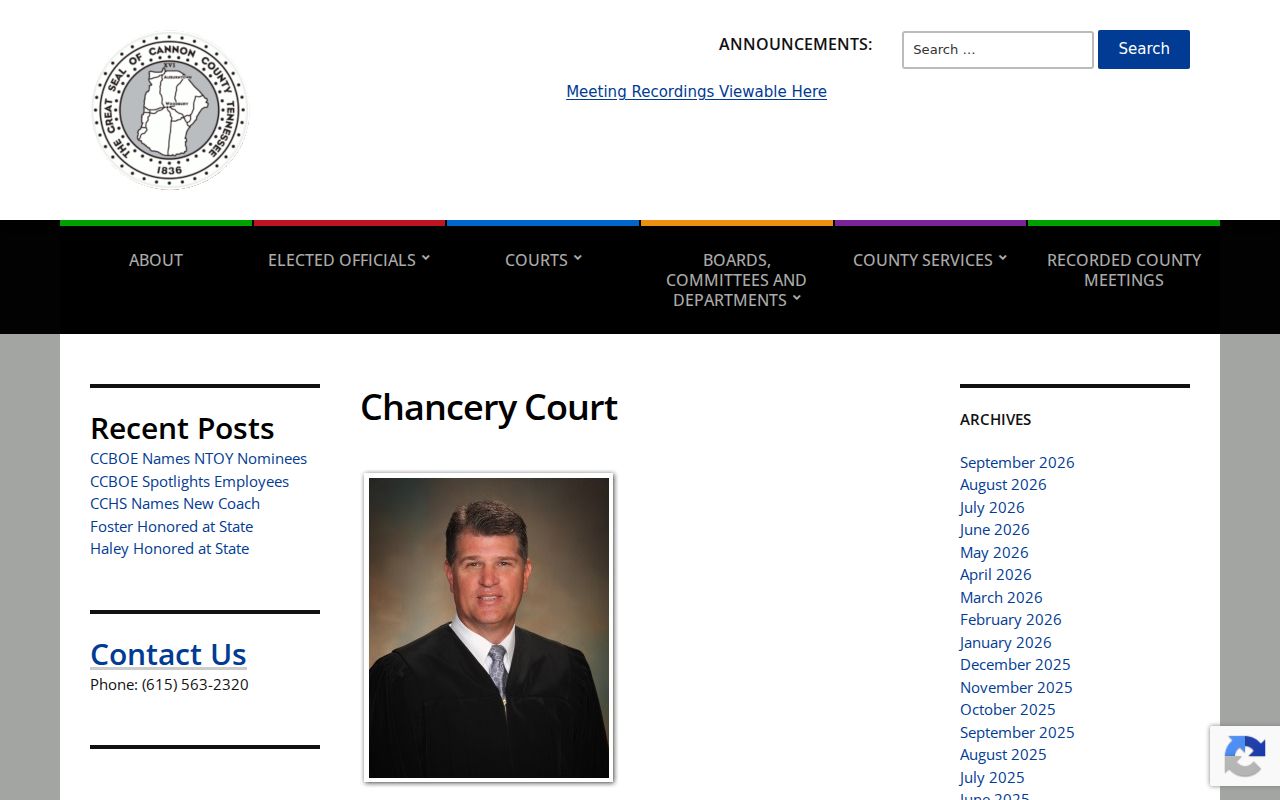
That page routes a Chancery request correctly. It spares you from pushing the request through a county portal that has no Chancery filter at all.
Cannon County Clerk and Master
200 West Main Street
Woodbury, TN 37190
615-563-5936
dana.davenport@tncourts.gov
Give the case number, style, date range, and the exact record sought. Ask whether the file is public. Also ask about redacted copies, fees, and certification. Cannon County posts no civil-copy fee sheet, so current cost estimates come from the clerk herself.
Cannon Civil Forms Are Not Filings
Tennessee's Administrative Office of the Courts publishes court-approved General Sessions civil forms. These help you name a document. Think civil warrant, fee request, sworn denial, or installment form. A blank form proves nothing. It does not show that any paper was filed in a Cannon County civil case. Nor does it reveal the docket's event history. The state General Sessions civil-form index lists that official set of forms.
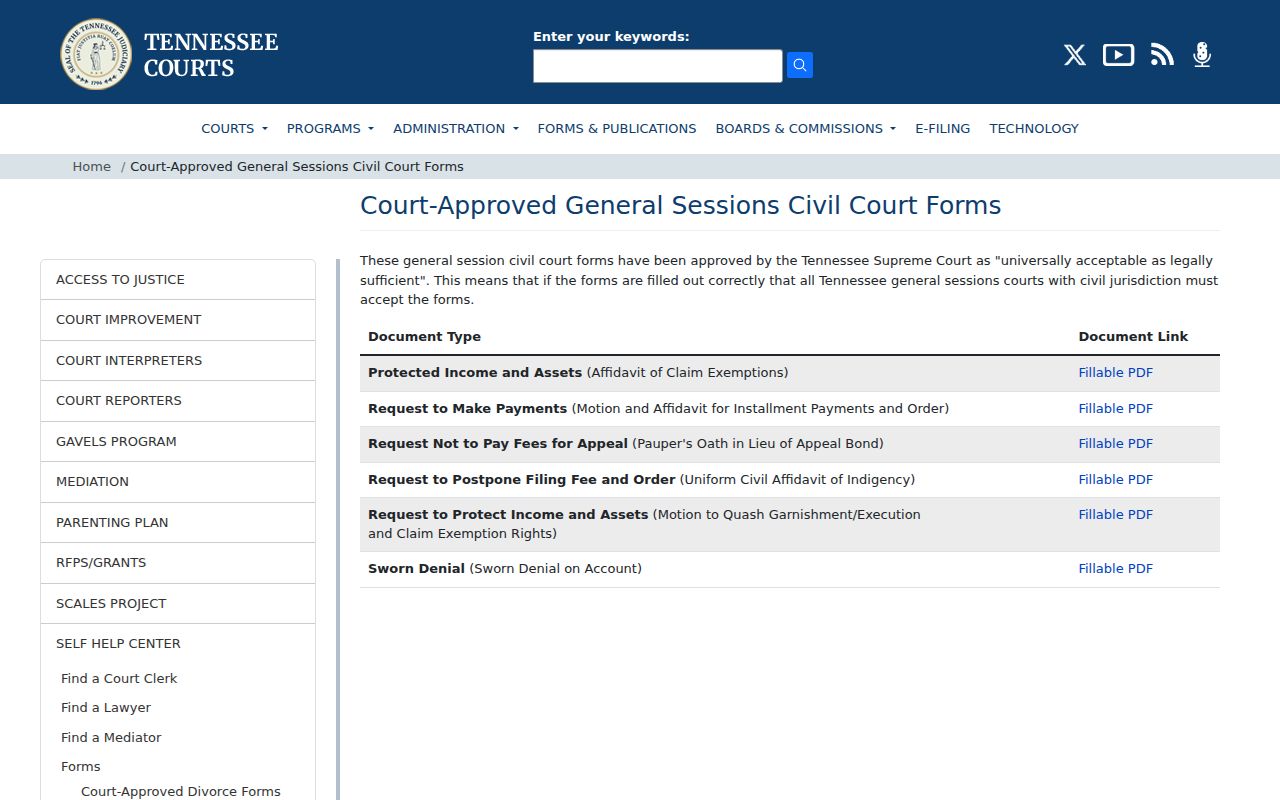
A form list can clarify a document title. It cannot tell you whether that form sits in a specific Cannon County case. The clerk confirms the current filing method. Cannon County offers no public trial-court e-filing endpoint. Tennessee Rule 5B permits electronic filing only where the court or clerk has adopted it under local procedures, and the county case-search portal is not an e-filing system.
Public Access to Civil Dockets
Tennessee Supreme Court Rule 34 generally opens civil court records to the public. Statutes, court rules, sealing orders, protective orders, redaction, and reasonable clerk procedures still limit that access. The Tennessee Public Records Act governs access. It shapes how a clerk responds too. Neither law makes every filing public. Family, juvenile, protected, or sealed material may be withheld in whole or in part.
Access boundaries:
Tennessee Supreme Court Rule 34 provides the court-record access framework and recognizes lawful exceptions.
Tennessee Open Records Counsel guidance explains that a custodian generally must respond within seven business days by producing, denying in writing, or estimating time and cost.
Tennessee Code § 10-7-504 addresses confidential records and exceptions to access.
The seven-business-day framework covers the response, not delivery. Retrieval, review, redaction, or storage can stretch longer. If access is limited, ask for the legal basis and whether a redacted or segregable public portion can be released.